Why Credit Union Checking Beats Big Banks—and How to Leverage It for Lifetime Growth

For credit union executives, member acquisition is often framed around marquee lending products: auto loans, mortgages, or high-yield HELOCs. However, focusing solely on high-margin credit products overlooks the single most valuable piece of real estate in retail banking: the humble checking account. Why is a credit union checking account better? Because it takes care of you better than a bank checking account.
The checking account is a consumer’s primary financial engine. It receives their direct deposits, handles their daily payments, and dictates their financial routines.
While big banks traditionally view checking accounts as fee-generating mechanisms, credit unions possess a structural advantage that makes their checking offerings vastly superior. More importantly, when marketed correctly, the checking account becomes the primary anchor for cross-selling a member’s entire financial life.
Here is why credit union checking accounts consistently outperform bank alternatives—and how leadership teams can strategically leverage them to drive product density and long-term portfolio growth.
Why Credit Union Checking Accounts Inherently Beat Big Banks
Credit unions operate under a cooperative, not-for-profit structure (regulated by the NCUA under 12 CFR Part 748 and associated guidelines). Free from the burden of delivering quarterly dividends to external Wall Street shareholders, credit unions pass profits back to their member-owners.
This structural difference creates a clear competitive advantage in daily transactional accounts:
1. Favorable Fee Structures and Low/No Minimums
Major commercial banks frequently slap checking accounts with monthly maintenance fees, strict balance minimums, and aggressive overdraft penalties to boost non-interest revenue. Credit unions, by contrast, excel at offering true free checking—or accounts with easily waivable tiers—alongside lighter, consumer-friendly fee models.
2. High-Yield “Reward Checking” Capabilities
Because credit unions reinvest earnings into member returns, many offer high-yield dividend checking accounts (often returning rates far higher than standard bank averages for members who meet basic debit card transaction thresholds).
3. Shared Branching and Fee-Free ATM Networks
A common misconception among prospective members is that credit unions lack physical reach compared to national bank branch footprints. In reality, through cooperative networks like the CO-OP Shared Branch (5,600+ locations) and CO-OP ATM network (30,000+ surcharge-free ATMs), credit unions offer physical and transactional access that rivals—and often exceeds—the nation’s largest banks.
The “Anchor Account” Strategy: How Checking Drives Product Density
In retail banking, stickiness is everything. A consumer with a standalone auto loan will leave the moment a lower rate appears online. But a member who holds their primary checking account with your credit union has a significantly higher retention rate and lifetime value.
When a member sets up direct deposit and automatic bill pay, your institution shifts from a transactional vendor to their primary financial institution (PFI).
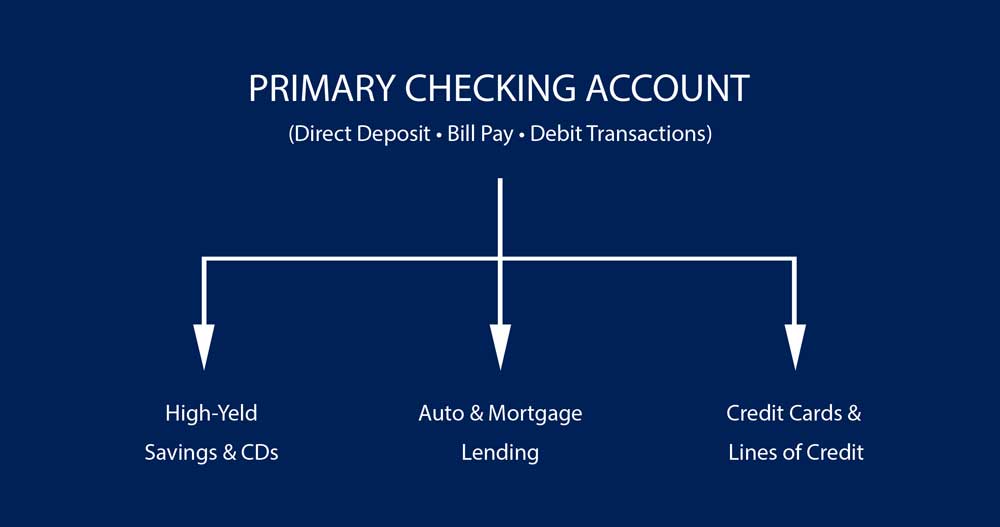
By viewing checking as the “front door” rather than a standalone product, credit unions can unlock powerful cross-selling opportunities across the institution:
1. Automated Rate Discounts on Auto & Personal Loans
Use your checking accounts as an incentive for lending products. Offer a 0.25% or 0.50% APR discount on auto or personal loans if the member sets up automatic loan payments originating from a credit union checking account backed by direct deposit. This lowers credit risk for the institution while cementing primary account status.
2. Frictionless On-Demand Credit & Overdraft Lines
Members who maintain active checking accounts generate consistent cash flow and behavioral data. Credit unions can leverage this internal data to pre-approve members for credit cards or personal lines of credit right inside their digital banking portal—offering timely financial lifelines before the member shops at an outside bank.
3. Micro-Savings & Auto-Stash Integrations
Modern checking accounts can feature automated “round-up” capabilities, sending spare change from daily debit transactions directly into a high-yield savings account or money market tier. This introduces checking members to wealth-building products without requiring manual effort on their part.
Actionable Marketing Tactics for Credit Union Executives
To turn your checking account portfolio into a growth driver, your marketing strategy must shift from passive product listing to active lifecycle management:
- Lead with Financial Relief, Follow with Mission: While “community roots” build long-term trust, prospective members shop with their wallets. Market your checking accounts by leading with concrete value—such as zero monthly fees, early payday via direct deposit, or cash-back debit rewards—and then introduce the member-owned cooperative mission during onboarding.
- Streamline the Switching Process: The primary barrier to opening a new checking account isn’t lack of interest; it is the perceived hassle of moving direct deposits and recurring bill payments. Invest in automated switch-kit technology within your digital banking platform to make transitioning from a big bank a 5-minute task.
- Data-Driven 90-Day Onboarding Triggers: The first 90 days after account opening dictate whether the relationship becomes sticky. Automate targeted, educational communication sequences during this window:
- Day 1–14: Encourage direct deposit setup and debit card activation.
- Day 30: Introduce digital wallet integration and mobile deposit features.
- Day 60–90: Introduce secondary products—such as low-rate credit cards, high-yield savings tiers, or pre-approved auto refinancing.
Checking accounts may not carry the high interest yields of mortgage portfolios or commercial loans, but they are the bedrock upon which primary member relationships are built. By offering lower fees, superior network access, and rate-reward structures, credit unions hold a distinct advantage over commercial banks.
By treating the checking account as the core anchor of your product strategy, your executive team can lower acquisition costs, boost member retention, and effortlessly scale borrowing and saving across the entire institution.