Over the years we have written many articles about social media and your credit union, so it is time to cull through them to consolidate them in an effort to make life easier for you. We will surely return to this topic, but this should be plenty to keep you busy. We will look at content strategies and controversies. Let us start with social media audits.

When Was Your Last Social Media Audit?
How Credit Unions Can Master the Social Media Audit for Community Engagement and Growth
In today’s digital-first world, a credit union’s social media presence is far more than just an online brochure; it’s a dynamic extension of its community presence. For credit union executives, simply “being on social media” isn’t enough. A strategic and thorough social media audit is indispensable to leveraging these platforms for deepening community ties, enhancing member engagement, and attracting new members. This audit isn’t just about analytics; it’s about understanding how your digital footprint can amplify your cooperative mission. So it is time to ask, when was your last social media audit?
What is an audit?
A social media audit comprehensively reviews your credit union’s performance across all active platforms. It begins by looking honestly at where you are present – Facebook, Instagram, LinkedIn, X (formerly Twitter), perhaps TikTok, or others. For each platform, you’ll analyze key metrics: follower growth, engagement rates (likes, comments, shares, saves), reach, website clicks, and even negative feedback. Beyond the numbers, delve into the type of content that resonates most with your current audience. Are they engaging with financial literacy tips, community event highlights, employee spotlights, or product promotions? This data provides a crucial baseline for understanding your current impact and identifying areas for improvement.
Once you have this baseline, the real work of connecting with your community begins. Your audit should reveal opportunities to immerse your credit union more deeply in local events. Are you sponsoring local sports teams, school programs, or charity drives? Make sure your social media actively reflects this. Post live updates from events, tag community partners, and encourage members to share their experiences using a unique hashtag. This showcases your commitment to the community and extends your reach through shared content and user-generated buzz. Actively search for and engage with posts from local businesses, community leaders, and non-profits – liking, commenting, and sharing their content to demonstrate genuine interest and partnership.
New members
Attracting new members through social media hinges on a two-pronged strategy: demonstrating value and fostering connection. Your audit should help identify which content types successfully attract new eyes. Beyond highlighting competitive rates, focus on sharing stories that resonate with your target demographic – perhaps testimonials from members whose lives you’ve positively impacted, or short videos explaining complex financial concepts in an approachable way. Utilize targeted advertising campaigns on platforms like Facebook and Instagram, leveraging geographic and interest-based targeting to reach potential members within your field of membership who are already engaging with similar content or local businesses.
Finally, the social media audit isn’t a one-time task; it’s an ongoing process. Regular reviews (quarterly or biannually) allow your credit union to adapt to evolving platform algorithms, changing member preferences, and emerging community needs. By consistently analyzing your performance, actively engaging with local events and tagging relevant partners, and strategically crafting content that showcases your unique value proposition, credit unions can transform their social media presence from a mere marketing channel into a powerful engine for community growth, member loyalty, and sustained success.

How to Build CU FOM Content Strategy
Content is king in the digital world. Sometimes it is completely overwhelming to keep up with the current posts. Getting your content to your members will have its ups and downs through the process of getting into the flow of the streams of content. One thing that will be a lifesaver is developing a content strategy. Not only will the following steps help you gain more understanding of your field of membership, but they will also provide valuable, informative trends to adjust and expand your strategy! So, let’s look at how to build a CU FOM content strategy to help grow your credit union’s membership.
Strategy Suggestions
- Define your goal
- What is your goal for growth? Membership, auto loans, and/or home equity? Put your priorities in order so you can easily determine the subject of content and frequency.
- Research and create personas of your Field of Membership prospects
- Time to really dig into your field of membership and see what media channels they’re using. Check out our article on creating personas for more in-depth information.
- Summarize your current content standing
- Get a rundown of your current content, your followers/friends on social media, your current clicks/impressions, etc. so you can assess your growth along the way.
- Choose channels, techniques, and budget
- Decide where you’ll be posting, acquire management applications for those channels, create timelines/schedules, and allocate a budget.
- Brainstorm content ideas
- Time to get creative and brainstorm a good amount of content ideas that match your goals and personas. Decide if you want to make videos, images, blogs, etc.
- Publish and manage your content
- Make your shareable content and schedule it into your content calendar! Start publishing and engaging with your online community.
- Measure results and try different techniques
- Promote ads and measure ROI as well as native and paid engagement from your content ads. Try different techniques and find your content strategy sweet spot!
Oak Tree Business Systems is here to help credit unions, and our forms are the best way to grow your credit union membership as they make it easier for potential members to sign up. We are also posting credit union blog posts to help with your credit union marketing.

Members Beyond the Screen
Building Authentic Member Relationships in a Digital Age
How does a credit union foster genuine member relationships in the era of instant communications and digital transactions? This challenge is one all credit unions must face. While digital tools offer unprecedented convenience, they can also create a sense of detachment. However, with strategic planning and a focus on human connection, credit unions can leverage technology to build stronger, more loyal member relationships than ever before. It’s important to build a relationship with your members beyond the screen.
The key lies in finding the balance between digital efficiency and personalized engagement. Begin by creating a seamless and user-friendly digital experience. Ensure your online and mobile platforms are intuitive, responsive, and secure. Offer personalized financial dashboards that give members a holistic view of their finances and integrate features that allow easy communication with credit union representatives. This level of digital convenience is essential, but it’s just the foundation.
Going Beyond
Credit unions must go beyond transactional interactions to truly build lasting relationships. Leverage data analytics to understand member behavior and preferences. Use this information to personalize communication, offer tailored product recommendations, and anticipate member needs. For example, if a member consistently uses online bill pay, offer them budgeting and financial planning resources. If a member is nearing retirement age, proactively reach out with information on retirement planning services. This personalized approach demonstrates that you value each member as an individual.
Don’t underestimate the power of human connection in the digital realm. Utilize video conferencing for personalized consultations, host virtual financial literacy workshops, and create online communities where members can connect and share experiences. Respond promptly to online inquiries and social media comments, and ensure that your online presence reflects the credit union’s values and commitment to member service. Even simple gestures, like sending personalized birthday messages or acknowledging member milestones, can go a long way in building rapport.
Finally, remember that the digital world is an extension of your physical presence, not a replacement. Maintain a consistent brand identity across all channels, and ensure that your online interactions reflect the same level of warmth and professionalism members experience in your branches. Encourage members to visit your branches for personalized consultations and community events and use digital tools to promote these in-person interactions. By integrating digital and physical experiences, credit unions can create a holistic and engaging member journey that fosters loyalty and strengthens relationships in an increasingly digital world.
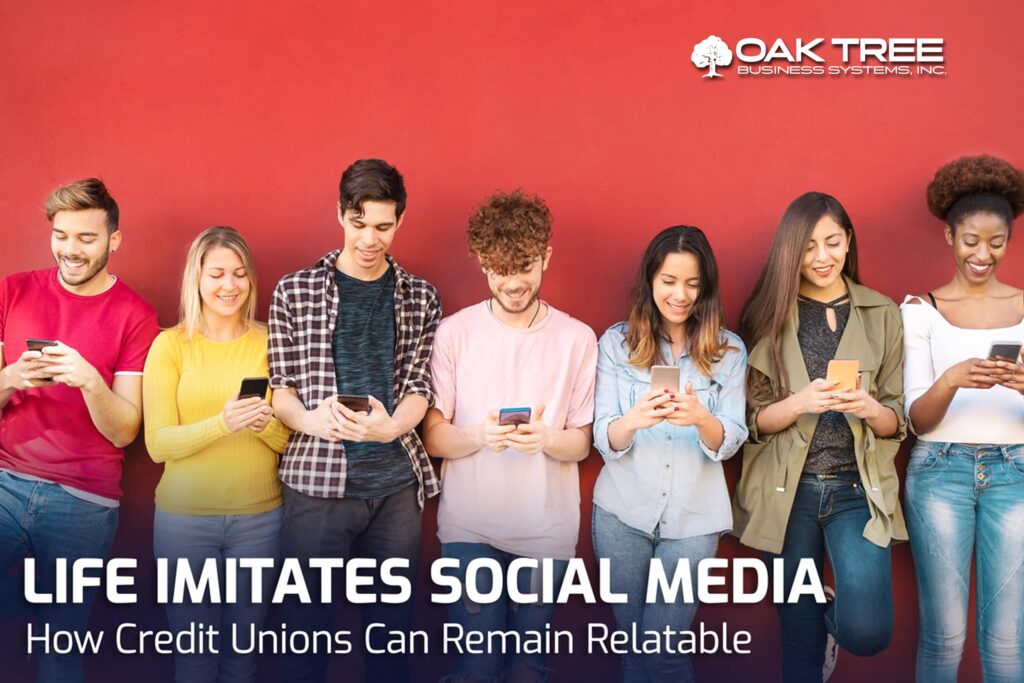
Life Imitates Social Media
How Credit Unions Can Remain Relatable
A whopping seven-in-ten Americans are active on social media. On Facebook alone, 75% of users check their accounts at least once a day. As popular social media platforms like Facebook, Twitter, and LinkedIn are constantly competing for our time, we take a look at how this is affecting CU members and CUs as a whole. It used to be life imitates art was the question, but now it is life imitates social media or vice versa.
Why are we so easily influenced?
In a current generation of cyber babies, most new arrivals are exposed to online content well before the recommended age of 2 years, and at levels that rival adult use. Children are given a smartphone while they eat, while their parents work, and during transport from point A to point B.
By the teenage years (and increasingly earlier), they are creating their digital profile. A fictional character of sorts that molds and evolves based on popular public opinion. Each year, this profile of personal experimentation requires an increasing number of hours to handle the growing number of virtual friends.
As social media takes our filtered selfies and gives them wings, we oddly defy social isolation by in turn craving instant feedback. We morph our social media posts for the audience we want to take notice of. If that avenue fails, there is always another path to stroll down. Unfortunately, it’s this knee-jerk reaction that begins to warp our sense of self and privacy.
We begin to share things online that we wouldn’t share with our close friends and family: secrets, weird habits, things that make us self-conscious… Social media is a license to share, and there are a few limitations.
The rise of the swipe
Perhaps no other social media app gives more of a neurological high than mobile games. These intuitive apps rely on tracking your behavior. Mobile gaming reached 2.2 Billion in 2020 with only 37% of mobile gamers being men, according to TechJury. Besides that, the percentage of adults owning a smartphone from 2011 to 2019 went up by 46%.
And while face-to-face meetings are decreasing, future generations may find more pleasure in swiping on a smart device than actually connecting with their true love in real life.
Understanding the member relationship with social media
So, how do we ensure that we are connected online and still excel via in-person interactions? While having social media accounts fulfill our need to be liked and noticed, we must balance this approval with real-life relationships, or risk losing ourselves in the process.
1. Instant connections
Before there were social media platforms, connecting with a CEO of a large company or a celebrity may have taken many social connections or cold calls. Now you can simply reach out to that person through social media without fear of rejection. Collecting a diverse base of contacts can open up a network of resources, instantly.
Exciting as this newfound freedom is, we can grow a virtual community larger than we can humanly handle.
2. Getting sucked in
Since it’s so easy to start and maintain a virtual relationship, it can be easy to prefer these over in-person meetings. While being active online has its benefits, it is easy not to place enough attention on face-to-face relationships that can stabilize our physical, mental, and emotional health.
3. Overwhelmed emotionally
If someone in your social network has a strong emotion toward you such as loneliness or anger, it is easy to become depressed or distant in our own social media posts. Even though we are participating in a virtual relationship, it can influence our real feelings.
4. Comparison trap
The popular “Like” system on social media has turned into a virtual team-building ritual. While you may not like your friend’s photo, you still may “Like” it, knowing that your friend will return the favor.
Since feedback on social media is instant, it is much easier to form large groups that follow the same opinion. However, social pressures to post frequently and with perfection can cause unnecessary anxiety and loss of an individual’s morals, values, and ultimately, self.
How CUs can relate to their members on social media
It is easy to feel defeated when we are trying to compete with other credit unions and big banks. Social media can exponentiate this feeling and cause us to get off track.
Remember to closely monitor social media messaging and put your members’ problems first. Through the successes and pain points, you can provide genuine transparency to your employees and members, while keeping them at the forefront.
Need a little guidance on how to stay relevant on social media? Check out a few ways credit unions and big banks are staying relatable without compromising their mission.
Think Outside the Box
Find what separates you from your competitors and capitalize on it. The more unique, the more likely your members are to share it.
For example, share posts with behind-the-scenes pics, partnering businesses, or a unique financial tip.
Utilize your employees
Empowering your employees to grow your social media outlets can generate 8 times more engagement than posting from the main credit union handle.
For example, have employees share pictures of themselves along with a few questions that help members get to know your staff better. Have the employees use their own social media accounts to further their reach. Humanizing your credit union can build a sense of community and foster engagement.
Tip: It is important to have social media guidelines when involving your employees. Responses should be polite and clear.
Upgrade your mobile app
Social networking profiles are held by 79% of the U.S. population, according to Statista (2019). As the population continues to gravitate toward using a smartphone rather than a desktop, the focus should be placed on a mobile-friendly solution. Keep up with marketing trends.
Frequently update your accounts
Especially with the state of the world right now, credit unions should be posting on their social media more frequently than ever before. As people are quarantined in their homes, the scroll is what keeps them from spiraling into a black hole of bad news.
Update your operating hours so members don’t have to pick up the phone. If you are getting the same question over and over, post the answer on social media so everyone can benefit. Sprinkle in a few member testimonials.
However, don’t over-post. If it isn’t useful information, you run the risk of over-posting. Overcrowding your account with memes or sales pitches can get old, fast.
Everyone Likes to be Accepted
Although social media removes barriers that would normally impede our social life, at the end of the day we are social creatures who need acceptance. Our local communities are declining in real life, so most people turn to social media to fill that role. It is not just Millennials that your messages need to be sent to.
It is up to credit unions to find the balance between in-person and online interactions to keep communities strong and stay competitive in a volatile financial market. Ask yourself, how does your CU elevate social media?

Avoid Members “Unfriending” Your Credit Union
How to Avoid Credit Union Members “Unfriending” Your Credit Union
Every one of us has had the experience of someone online “unfriending” us. Gasp! Maybe they didn’t like something you said, maybe they thought you were someone else, or maybe they just didn’t like you to begin with and were simply tolerating your presence. Who knows? What we do know is you definitely don’t want that online phenomenon to carry over into your credit union membership. Members “unfriending” you can spell big trouble. The following are a few tips to encourage your members to stay on “friendly terms” with your credit union.
How to Avoid “Unfriending” – Stay on “Friendly Terms” with Members
- Know their names. Train your staff to call your credit union members by name. Whenever you call someone by their name it shows that you see them as an individual rather than just a customer. Calling a member by their name shows interest in them personally and that you respect them as an individual. Dale Carnegie says, “A person’s name is to him or her the sweetest and most important sound in any language.” As such, train your staff to greet each member by their name. What if they don’t know the member’s name? Simple… Ask.
- Get to know their needs. It’s important for your credit union staff to understand the financial needs of your members. Doing so allows them to market other products and services that, otherwise may be overlooked. Of course, Oak Tree has the perfect forms package to suit any personal lending need, from automobiles to home mortgages and more. Our consumer lending package is always compliant and up to date. However, before you can sell these products or services, you must get to know your members to understand what their needs are.
- Market, market, market. Developing a strategic marketing plan for member retention has a side benefit. It encourages new member growth. The more involved with your credit union a member becomes, the more natural it will be for them to bring you up in daily conversations they have with friends and family. If you are servicing all of their financial needs, and doing a good job, then you should expect new members as an indirect result. It’s what happens when a solid marketing plan is coupled together with great customer service. The powerful one-two combo cannot be denied. Your members will thank you by sticking around, and bringing their friends along, too.
Member Retention
Finally, member retention is necessary. As more regulations are certain to occur, it is imperative that membership remains constant in order for credit unions to market other services to existing members. It’s a challenge for sure, but it is possible. Do it well, and enjoy loyal members for years to come. As for social media, well, you are on your own.

Navigating the Digital Tightrope
How Credit Unions Can Avoid Social Media Controversy
In today’s interconnected world, a credit union’s social media presence is no longer optional—it’s a vital extension of its brand and a primary channel for engaging with members. Yet, for many executives, the prospect of managing social media can feel like navigating a minefield. One wrong post, an insensitive comment, or a misstep in a viral trend can spark a firestorm, leading to reputational damage, member dissatisfaction, and regulatory scrutiny. The challenge is clear: how do you maintain an authentic, human voice online without getting into “hot water”? The answer lies in a proactive, well-defined strategy that prioritizes transparency, compliance, and genuine member empathy. Let’s develop a game plan to prepare you and your credit union for navigating the digital landscape and avoiding negative online attention.
1. Build a Foundation of Policy and Governance
Before scheduling a single post, your credit union must have a clear and comprehensive social media policy. This isn’t just about what employees can post on company channels; it must also include guidelines for their personal social media use to prevent unintentional brand association or the sharing of confidential information. This policy should outline:
- Content and Tone Guidelines: What is the approved brand voice? What topics are strictly off-limits (e.g., politics, sensitive social issues)?
- Compliance Checkpoints: A clear process for ensuring all marketing materials, including social posts, comply with regulations like the Truth in Lending Act (TILA), Truth in Savings Act (TISA), and the FFIEC’s social media guidance. Every promotional post should have a checklist to ensure it contains all necessary disclosures.
- Monitoring and Archiving: You are responsible for all content on your social media pages, including member comments. Implement tools to monitor posts for customer complaints or sensitive data, and a system to archive all communications for regulatory record-keeping purposes.
2. Prioritize Authenticity, Not Perfection
The biggest social media risk for a credit union is often being perceived as a faceless, corporate entity. Members don’t want to talk to a robot; they want to engage with a trusted partner. The goal is to be authentic, which means showcasing your credit union’s human side.
- Spotlight Your People: Feature employees and their stories. Share behind-the-scenes glimpses of staff training, community events, or even fun team moments. This humanizes your brand and builds trust.
- Embrace User-Generated Content: Encourage members to share their stories or photos related to your credit union and, with their permission, feature this content. This builds a powerful narrative of community and member empowerment that is far more compelling than polished stock photos.
- Speak with a Local Voice: Your credit union has a unique local presence that big banks can’t replicate. Share stories about local events you sponsor, highlight community wins, and use regional humor. This local authenticity is your strongest competitive advantage.
3. Have a Crisis Response Plan Ready
Even with the best preparation, a controversy can emerge from an unexpected source. A disgruntled member’s post could go viral, or a negative news story could prompt a backlash. Having a pre-defined crisis communication plan is essential for a swift and professional response. This plan should include:
- Designated Responders: A small, empowered team authorized to handle social media inquiries and crises.
- Escalation Protocol: A clear process for identifying and escalating posts that contain serious complaints, legal threats, or confidential information.
- Pre-Approved Responses: Templates for common issues, vetted by your compliance and legal teams. This allows you to respond quickly and consistently without risking a misstep. The key is to respond promptly, professionally, and with empathy, then move the conversation offline to a private channel.
The Return on Investment: Trust and Loyalty
For credit union executives, a well-managed social media presence is not a risk to be avoided but an asset to be leveraged. By building a strategic foundation of policy, prioritizing authentic content that reflects your mission, and being prepared to handle any controversy, you can transform social media from a potential liability into a powerful tool for building trust, strengthening member loyalty, and reinforcing your credit union’s position as a community pillar. In the end, staying out of hot water is about being true to who you are, both on and offline.
Is Your Credit Union’s Foundation Prepared for All Risks?
As you build a resilient social media strategy, remember that a strong operational foundation is key. Oak Tree Business Systems provides meticulously crafted, compliant credit union membership forms and essential consumer lending documents that streamline operations and ensure your institution is protected from the ground up.
Let us help you build a more secure and agile credit union. Contact us today to discuss your documentation needs!
Member Social Media Engagement Best Practices

In an expert opinion article posted on Credit Union Times, our CEO, Richard Gallagher discusses some great advice for credit unions seeking to use social media to engage with their members. It is time to look at credit union member social media engagement best practices.
Any form of credit union marketing now requires social media to be part of the equation. Consider these recent demographic statistics from the Pew Research Center as they relate to social media trends in 2018:
● 73% of male internet users and 83% of female internet users are on Facebook.
● 38% of female internet users are more likely to use Instagram than men (26%).
● 81% of millennials check their Twitter feed every day.
● 91% of all social media users check their platforms from a mobile device.
So, are you convinced that social media must be a part of your marketing plan? With that in mind, let’s highlight a few ways credit unions use social media to engage with their members, as well as some tips and tricks you can incorporate into your own marketing plan.
Richard Gallagher
To read more about how your credit union can better engage with its members online go check out the CU Times article and then check out our membership documents for your credit union so you can find even more members to engage with and apply these member social media engagement best practices.

Best Practices for Compliant Social Media Marketing
In a commentary article posted on Credit Union Times our CEO, Richard Gallagher, discusses Best Practices for CU Social Media Marketing to stay compliant.
Compliance authorities are bringing their A-game, and so should you.
Is your marketing compliant? Do you know what you can and can’t say? What about your social media posts? Are they compliant? These are big questions and they won’t be ignored. The compliance authorities are bringing their A-game, and so should you! Catching one examiner’s eye could end up costing you thousands if your marketing efforts breach certain parameters, and it doesn’t even require them to visit you onsite. Let’s take a closer look. It all begins with basic guidelines set forth by the CFPB.
Basic Marketing Guidelines
The guidelines were established by the bureau as an effort to protect consumer interests. Here are general guidelines to follow when advertising on print, television, and radio. All marketing and advertising efforts must: Be factual and accurately represented, clearly explain the product or service being offered, give no misrepresentation of cost or terms, make sure all disclosures are prominently displayed, and avoid using unfamiliar terms.
Keep in mind these are general guidelines. Essentially, the idea behind the guidelines is to make sure you communicate your message clearly and to describe the product or service being offered in an accurate, honest manner. This allows the consumer to make the best possible decisions regarding the product or service being offered.
Richard Gallagher
To read more about how your credit union can be compliant with their social media marketing go check out the CU Times article and then check out Oak Tree Marketing Services for your credit union.