A Brief History

The credit union movement is a fascinating one, with a rich history that dates back to the 19th century. The first credit union was founded in Germany in 1864. Friedrich Raiffeisen believed that everyone should have access to financial services, regardless of their income or social status. Let’s take a brief look at the history of the credit union movement, and the history of ATMs. Celebrate over a hundred years of the credit union movement!
The Beginning
The credit union movement quickly spread to other countries, including the United States. The first credit union in the US was founded in 1909 in Manchester, New Hampshire. The movement grew slowly at first, but it gained momentum in the 1930s, thanks in part to the Great Depression.
During the Great Depression, many people lost their jobs and their savings. Credit unions stepped in to provide much-needed financial assistance to these individuals. They offered loans at low-interest rates and allowed people to save their money in a safe and secure environment.
The credit union movement continued to grow in the years following the Great Depression. By the end of the 20th century, there were over 7,000 credit unions in the US, with over 80 million members.
The Growth of Credit Unions in the US
There are a few reasons why credit unions have been so successful in the US. First, they are not-for-profit organizations. This means that their profits are returned to their members in the form of lower interest rates on loans and higher interest rates on savings.
Second, credit unions are member-owned, which means that members have a say in how the organization is run. This gives members a sense of ownership and responsibility, which helps to foster a sense of community.
Third, credit unions are regulated by the National Credit Union Administration (NCUA); which helps to ensure that they are financially sound. This gives members peace of mind knowing that their money is safe.
The Future of the Credit Union Movement
The credit union movement is still going strong today, and it is poised for continued growth in the years to come. There are a few reasons for this. First, the financial services industry is becoming increasingly competitive, and credit unions offer a unique value proposition that is attractive to many consumers.
Second, the US population is becoming increasingly diverse, and credit unions are well-positioned to serve the needs of this diverse population. Credit unions are typically more community-focused than banks, and they are often able to provide more personalized service to their members.
Third, the rise of the Internet and mobile banking has made it easier for people to access credit union services. This has helped to expand the reach of the credit union movement and make it more accessible to people from all walks of life.
The credit union movement is a vibrant and dynamic one, and it is an important part of the US financial system. As the financial services industry continues to evolve, credit unions are well-positioned to continue to grow and serve the needs of their members.
Over 100 Years of Credit Unions

The first U.S. credit union opened in 1909. From the beginning, credit unions followed a unique concept. Credit Unions were created not for profit, but to serve members as credit cooperatives. Since then, over 100 years have passed, and there are 6,557 credit unions in the United States serving over 102 million members. Oak Tree wants to celebrate the first 100 years of credit unions’ history by looking back at how credit unions were started.
The Beginning
The creation of credit unions is credited to Friedrich Wilhelm Raiffeisen, the mayor of a small German town whose residents were struggling financially. His idea was to create a small pool of the community’s money that would allow the residents to get small loans at a low interest rate. This idea later spread to other countries, expanding throughout Europe, India, and making its way to Canada in 1901.
Credit unions later expanded into the United States in 1909, with the first credit union opening in New Hampshire. This same year, Massachusetts passed the first state credit union law, which is the Massachusetts Credit Union Act. In the 1920s, credit unions gained popularity in the U.S. as demand for loans grew when people sought loans to buy cars and large household appliances. Credit unions saw a large need in the market for low-interest loans, so they began promoting credit unions to the public, and soon after, Massachusetts opened up 19 new credit unions.
The Demand for Credit Unions
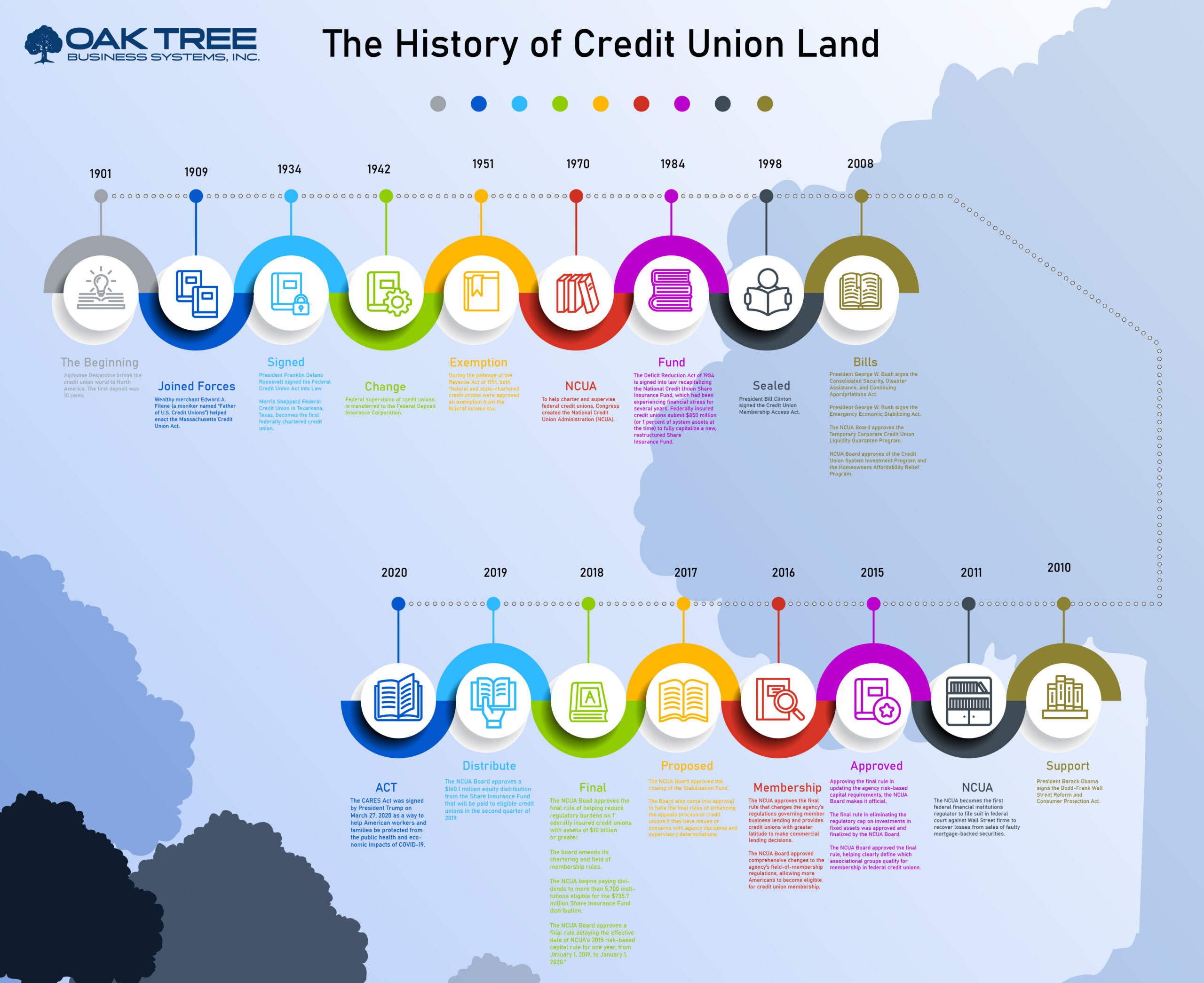
By seeing what a great demand there was for credit unions in the market, philanthropist Edward Filene “organized and Roy Bergengren managed a national association—the Credit Union National Extension Bureau—to promote the establishment of credit unions throughout the United States” (NCUA). In 1934, President Roosevelt passed the Federal Credit Union Act. Growth for credit unions was steady during the ’40s, ’50s, and ’60s. In 1970, the National Credit Union Share Insurance Fund allowed federal deposit insurance to be extended to credit unions. Also, in 1970, the NCUA was founded to regulate credit unions.
The 1970s
In 1977, more laws were passed that allowed credit unions to offer more services to their members. The ’70s were an extraordinary decade for credit unions, as they nearly doubled the number of credit union members during that period of time. The 1980s showed hard times in the United States with double-digit inflation, a recession, and high-interest rates, but credit unions still continued to grow. Assets grew steadily despite the fact that the number of credit unions dropped due to mergers. The 1990s brought more changes to credit unions with the Membership Access Act and the signing of the Credit Union Membership Access Act by President Clinton in 1998. In 2008, credit unions endured the 2008 recession, and by 2014, there were over 100 million credit union members in the United States.
Today, credit unions remain strong and follow the same philosophy that they were founded on over 100 years ago. In fact, as of 2025, there are more than 4,400 federally insured credit unions in the U.S. serving over 142 million members, and still growing.
The distinguishing features include:
- Democratic governance
- Each member has one vote, regardless of the size of the member’s deposits
- Member-elected board of directors
- Volunteer-based
A Short History of Credit Union ATMs

Credit Unions know how important ATMs are to their members. The ability to withdraw cash instantly at any given time is something most people directly relate to their banking experience. The convenience of the Automatic Teller Machine wasn’t always available, though. Here’s a short history of credit union ATMs.
ATMs came into existence in the 1960s in Europe. The so-called “Father” of the ATM was John Shepherd-Barron, who came to the idea in his bathtub after he ran late and missed the closing of his bank on a Saturday, unable to pull out money for the weekend. The invention came from that and a combination of his love for chocolate. He believed pulling money from his financial institution should be just as easy as purchasing a candy bar from a vending machine. At the time, Shepard-Barron was working for a global currency printing company and had the idea of simply switching chocolate for cash. He took the idea to his supervisors, who then presented the idea to Barclays Bank in London.
The First ATM
The first ATM began dispensing cash in London on June 27, 1967. This machine used a one-time-use paper voucher system. It would mail the paper voucher back to the member to be used again. The paper vouchers had slightly radioactive isotope carbon-14 marks that the machine would read and match against a PIN. The PIN was also created by John Shepard-Barron, who began with a 6-digit number. It was his wife who refined this to only four digits, which she said would be easier to remember.
Shortly after, ATMs like Shepard-Barron’s original concept began showing up all over the world. The first ATM only withdrew cash, but it wasn’t long until a total teller system came into existence in 1971. Much like credit union ATM networks today, the first ATM did not charge a fee to withdraw money. This is one of many great things that differentiate credit unions from banks. Credit unions are able to offer their members ATM networks, which makes it possible for them to have access to their money anytime and anywhere, often fee-free and with few limitations, just like John Shepard Barron once dreamed of.
Oak Tree Business
Oak Tree Business Systems, Inc. is here to further assist you in making your members’ dream experience possible and enjoyable. With new technological innovation always on the horizon, Oak Tree is always in the know and up to date on your complaint form needs. We offer a wide range of Credit Union services from membership applications and lending documents to data linking and compliance training services. Email us at clientservices@oaktreebiz.com and let us get you the forms you need to set your members up for success. You never know – you could have the inventor of the next great technology in your midst.
The History of Credit Unions Infographic
Resources
National Credit Union Administration. “A Brief History of Credit Unions.” Web. 13 July 2015.
American Bankers Association. “Credit Unions: A Timeline (1909-Present).” Web. 13 July 2015.
Carolinas Credit Union League .”CU History & FAQS.” Web. 13 July 2015.
Minnesota Credit Union Network. “History of the Credit Union Movement.” Web. 13 July 2015.
Stokel-Walker, Chris. “A Brief History of the ATM.” Mental Floss. Felix Dennis, 25 Sept. 2013. Web. 1 March 2016.
Bellis, Mary. “The ATM Machine of Don Wetzel.” About Money. About.com, 04 Dec. 2014. Web. 1 March 2016.